What Lutein Does in the Eye
Lutein concentrates preferentially in the macula — the central 5mm of the retina responsible for sharp, detailed central vision. Along with zeaxanthin, it forms macular pigment: a yellow-orange filter layer that sits in front of the photoreceptor layer and serves two functions simultaneously.
Blue light filtration. The macular pigment absorbs high-energy visible light (415–455 nm) before it reaches the photosensitive outer segments of the photoreceptors. This reduces photo-oxidative stress on cone and rod cells — the same mechanism that makes sunglasses useful, but occurring at the cellular level inside the eye.
Antioxidant protection. Lutein and zeaxanthin are also direct antioxidants. They quench singlet oxygen and neutralize free radicals generated by phototransduction — the chemical process of converting light into neural signals. Photoreceptor outer segments are rich in polyunsaturated fatty acids, which are highly vulnerable to oxidative chain reactions.
Macular pigment optical density (MPOD) is the clinical measure of how much of this protective pigment you have. Low MPOD is associated with increased AMD risk. MPOD is measurable with non-invasive instruments (heterochromatic flicker photometry) and responds to lutein supplementation within 4–12 weeks.
The 10 mg AREDS2 Dose Explained
The AREDS2 trial (2013, JAMA) was a randomized, double-masked, multicenter clinical trial conducted by the National Eye Institute with 4,203 participants at risk for advanced AMD. Participants were randomized to receive either the original AREDS formula (with beta-carotene) or a modified formula substituting lutein 10 mg + zeaxanthin 2 mg.
The result: lutein/zeaxanthin reduced the risk of progression to advanced AMD by approximately 25% compared to the no-lutein/zeaxanthin group, across the 5-year follow-up. Crucially, beta-carotene was removed from the AREDS2 formula because it was associated with increased lung cancer risk in smokers — making the lutein/zeaxanthin substitution both more effective and safer.
Why 10 mg? The AREDS2 dose was chosen to be achievable and well-tolerated across a large trial population. It was not necessarily the dose that maximizes MPOD response — it was the dose the investigators selected based on the safety and tolerability data available in 2008 when the trial was designed. The 25% risk reduction was found at this dose; a higher dose might produce greater benefit, but this specific comparison wasn't tested in AREDS2.
The 10 mg/day dose is the minimum with definitive large-scale RCT evidence. It is the clinical standard and what most eye care physicians reference.
The Case for 20 mg/Day
Multiple smaller-scale studies have examined MPOD response to doses above 10 mg/day. The evidence points toward 20 mg/day as a meaningful threshold for maximizing macular carotenoid saturation:
- Bone et al. 2007 (Invest Ophthalmol Vis Sci): Found a dose-dependent relationship between lutein supplementation and MPOD response, with 20 mg/day producing significantly greater increases in macular carotenoid density than 10 mg/day over 6 months.
- LUXEA Study (2014, Br J Nutr): Compared 10 mg, 20 mg, and 40 mg lutein ester supplementation. MPOD response was greatest in the 20 mg group relative to dose; the 40 mg group showed diminishing returns.
- Ma et al. 2022 (Nutrients): Meta-analysis of 20 RCTs confirmed lutein supplementation increases MPOD, with the effect size larger in studies using higher doses (≥15 mg/day).
The practical interpretation: if your goal is supporting macular pigment density — which is the primary measurable protective mechanism — 20 mg/day appears more effective than 10 mg/day. The 10 mg AREDS2 dose is the evidence-based minimum, not the evidence-based optimum.
Safety at 20 mg: No established upper intake level (UL) exists for lutein from authoritative bodies including EFSA and the NIH. Multiple studies have used 20 mg/day for 6–12 months without adverse effects. The only occasionally reported side effect at high intakes is carotenodermia (yellowish skin tinting) — harmless and reversible.
VisiFlora and iGenics both contain 20 mg lutein per serving
Both formulas exceed the AREDS2 minimum at twice the tested dose. VisiFlora pairs it with the gut-eye axis ingredients; iGenics pairs it with bilberry, saffron, and turmeric.
Lutein in Food: Realistic Amounts
| Food | Lutein + Zeaxanthin | Serving to reach 10 mg |
|---|---|---|
| Cooked kale | ~47 mg per 100g | ~21g (3–4 large leaves) |
| Cooked collard greens | ~15 mg per 100g | ~67g (small serving) |
| Cooked spinach | ~12 mg per 100g | ~83g (½ cup) |
| Cooked Swiss chard | ~11 mg per 100g | ~91g (½ cup) |
| Raw parsley | ~5.6 mg per 100g | ~179g (very large amount) |
| Romaine lettuce (raw) | ~2.3 mg per 100g | ~435g (impractical) |
| Egg yolk | ~0.3 mg per egg | ~33 eggs (impossible) |
| Corn (cooked) | ~0.7 mg per 100g | ~1,400g (impossible) |
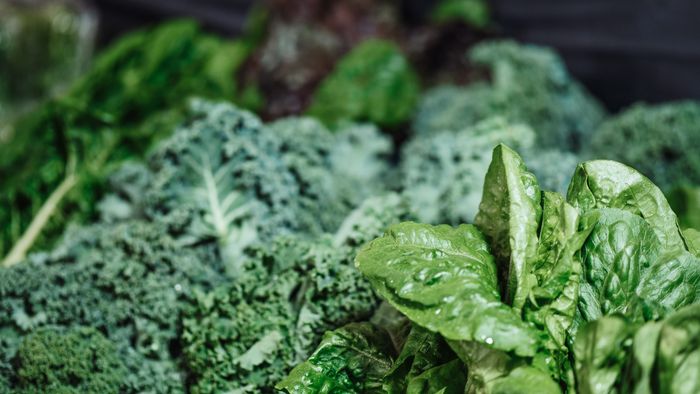
Cooked dark leafy greens are the only realistic food source for therapeutic lutein intakes. Cooking (steaming or sautéing) both breaks down cell walls to improve bioavailability and reduces volume — 100g cooked kale represents several times that weight raw. Eating with fat (olive oil, eggs) further increases absorption.
NHANES dietary survey data consistently shows average US adult lutein+zeaxanthin intake at approximately 1–2 mg/day — a 5–10× gap from the AREDS2 dose. This gap can only be closed through sustained dietary change toward very high vegetable intakes or supplementation.
How to Read a Lutein Supplement Label
Free-Form vs. Ester Form
Lutein appears on labels either as lutein (free-form, from saponified marigold extract) or as lutein ester (esterified form, from direct marigold extraction). Free-form lutein has been slightly better studied and is what AREDS2 used. Lutein esters must be converted to free-form by intestinal enzymes before absorption — this reduces the dose efficiency by approximately 40% unless taken with fat. A label claiming "20 mg lutein ester" delivers somewhat less free lutein than "20 mg lutein (free-form)."
Lutein:Zeaxanthin Ratio
Most formulas pair lutein with zeaxanthin. The AREDS2 ratio was 5:1 (10 mg:2 mg). Higher zeaxanthin proportions are not necessarily better — both carotenoids serve macular pigment functions but at different anatomical sites within the macula. Aim for at least 2 mg zeaxanthin with every 10 mg lutein.
Absorption and Timing
Take with a fat-containing meal. If your supplement is in a soft gel with an oil carrier (tocopherols, safflower oil), bioavailability is typically better than powder-in-capsule formulations even when taken without food.
Which Supplements Reach Therapeutic Doses
Many popular eye supplements are underdosed for lutein. AREDS2 minimum is 10 mg; the research-supported optimum for MPOD response is 20 mg:
- PreserVision AREDS2: 10 mg lutein / 2 mg zeaxanthin — matches AREDS2 exactly. The clinically-validated minimum, at roughly half the cost of specialty formulas. → VisiFlora vs PreserVision comparison
- iGenics: 20 mg lutein / 10 mg zeaxanthin — 2× AREDS2 carotenoid dose, with bilberry 480 mg and saffron 20 mg for additional macular support. → iGenics full review
- VisiFlora: 20 mg lutein / 4 mg zeaxanthin — also 2× AREDS2 lutein dose, combined with gut-barrier nutrients (quercetin, rutin, grape seed). → VisiFlora full review
Red flag: Supplements listing "lutein complex" without a specific mg amount, or formulas below 10 mg lutein, are not meeting the studied therapeutic threshold. Label transparency on exact doses is a quality signal.